Curry and Chips: Racism and Satire in 1960’s British Television
Introduction
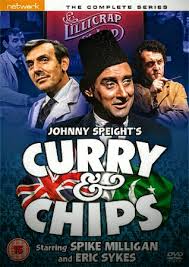
“Curry and Chips” is a television series aired on British networks in November 1969. The proposed idea of satirizing racism was poorly received by the network company Independent Television (ITV), who pulled it off air after only six episodes were released. “Curry and Chips” portrays a cast of factory workers, majority of whom are White, and the newly immigrated Irish-Pakistani Kevin O’Grady, who is played by the controversial White actor, Spike Mulligan, in brown face while using a mocking south asian accent. This edition serves as a reference to the events in history that led to the creation of this series, like the growing immigrant population in the United Kingdom, changing the demographics of the working class. This edition also explores how satire emerged as a genre in British television, along with an examination of the audience that “Curry and Chips” was created for.
By highlighting individual scenes that portray racism, the dynamics of the working class, and satire, we provide topical and clear examples as a reference point for the themes within the edition and from within the original source. This edition is limited to six scenes within the first episode in order to give readers an idea of the source and what it represents in a wider context of the post-colonial atmosphere of Britain in 1969. “Curry and Chips” is a unique source because it provides multimodal context to what the approach was to racial issues and social unrest in the decades post-decolonization and the World Wars.
The Source
This edition provides the link to a digital version of Curry and Chips available on the Internet Archive containing all six episodes, but due to the fragile state of digital archiving and unforeseeable changes in technology that might make this source inaccessible, transcriptions of select scenes have been included from Curry and Chips Season 1, Episode 1 that are representative of the social and cultural context from which Curry and Chips originated. Below are excerpts depicting complex racial interactions, the social interactions of the working class, and satire in 1960s Britain.
[https://archive.org/details/s01e06_202002/Curry.and.Chips.S01E01.mp4]
About the Source
In post-colonial Britain, there was a steep rise in immigration which created tension within the working class. In 1947, with the partition of India and Pakistan, many people were displaced because of these new borders, and the economic state of these nations was not fairing well considering that the British colonial empire had drained most of their wealth. During this time, opportunities for work brought South Asian immigrants to the British Isles, causing the Indian population in Britain to significantly increase; specifically, “Indian immigration had increased fourfold by 1961 and sixfold by 1962; Pakistani increases were twelve times by 1961 and twenty-five times by 1962.” 1
With the sharp spike of population growth over a short period of time, there became a stark rise in racial tension between often unskilled or semi-skilled immigrant workers and the white British working class. With these heightened racial tensions and an increasing immigrant population, the Commonwealth Immigration Law of 1962 was passed which restricted entry to only those with a work permit or those who were highly skilled 2. This legislation furthered the divide between white British workers and South Asian workers. This divide was also agitated by the collapse of the British empire and a loss of global power that had been culturally prevalent up until that point. A majority of British culture had been built around colonialism and with this collapse and immigrants from India and Pakistan coming to work in Britain, there became a greater systemic and cultural segregation of South Asian immigrants and their families from the white British working class. This caused a divide among neighbors and coworkers, which greatly shaped the South Asian experience while living and working in 1960s Britain.
Additionally, in the late 60s, conservative political figure Enoch Powell gave his “Rivers of Blood” speech in which he strongly opposed the rise in immigration that had been happening throughout the decade. His speech further revealed underlying racial tensions of the time and gave a greater cultural understanding of how the wider British population was reacting to immigration. His speech was also in reaction to the Commonwealth Immigrants Act of 1968, which further restricted immigration in Britain.3
Simultaneously, satire as a way of subjugating race with humor was becoming increasingly popular in British entertainment during the 1960s. Satire often poses to question culturally relevant and controversial subjects by criticizing them through exaggeration and humor, and in 1960s Britain subjects of race, immigration, and working class politics were in high contention. Satire as a way of dealing with this tension partly came about because of the integration of the television into working people’s homes. Film and television serials were no longer something that someone needed to make plans to go see because it was right there, in the home. This rise of satire in television comes in contrast with radio, which was the popular form of entertainment prior to the 1960s, because the effects of satire were better perceived with things like slap-stick comedy which required a visual element.4
With satire rising in popularity, it brought its own contentions from critics. During the 1960s in Britain, comedy was often used to “openly [parade]…prejudices and petty-minded attitudes of the different social classes in British society,” and these prejudices extended to race. Many were concerned that, while satire was meant to bring recognition to the racial tension in Britain at the time, that they were actually perceived as doing the opposite and were instead further re-enforcing negative stereotypes about South Asian immigrants and other marginalized groups. This was also specifically concerning because satire and comedy was seen as being used to “[maintain] and [shape] ethnocentric attitudes” of the time, further dividing the South Asian working class from the white working class in Britain.5
Despite these concerns there were many television shows being produced at the time with race as a central part of the story. Some such shows included Till Death Us Do Part (1965) & Curry and Chips (1969), both of which were directed by Johnny Speight and were satirical comedies concerned with how race and class intersected in 1960s Britain. Many of these shows faced backlash from their use of offensive racialized language and slurs, as well as the exaggerated stereotypes that were used for comedic effect. One major contention between these shows and their audience was whether what was being depicted was effective satire, or rather a way to push “anti-liberal messages… presented as laughable satire.”6
In Curry and Chips, Spike Milligan in brown face, plays Kevin O’Grady who is an Irish-Pakistani immigrant worker. O’Grady is often used as the punchline for the joke because he is portrayed as out of place among the white workers in the factory. There is also blatant racism within the show in the use of various slurs and derogatory terms, all within the first episode.7 This representation reinforces the white working classes views in Britain at the time by not actively subverting these racial stereotypes and at times playing them up for comedic effect. The audiences and television networks tended to agree that this way of portraying racial tension was unproductive and offensive to South Asian people, which ultimately led to the show’s run from from November to December 1969 to be cut short because of its support of negative views of different racial and ethnic groups that reinforced harmful widespread cultural beliefs at the time.
About the Edition
The original version of the television show Curry and Chips is not accessible through its original source, London Weekend Television on the ITV Network. However, it is readily available on YouTube and streaming services like Plex, where the six-episode season is posted for public viewing. Although the episodes remain under copyright by London Weekend Television, they are still accessible for public display.
The full six-episode series can be found on physical DVD copies, which are still being exchanged through secondary markets like eBay. Additionally, the Internet Archive offers the whole season on its website, serving as a non-profit source for information and entertainment for historians and researchers. 8
The procedures used for presenting this source involved taking various points from the first episode of the show and capturing still images of specific scenes. The use of still images allows for more context of the scene itself. To alter the images slightly, applications like Adobe Photoshop helped present the highest quality picture for the edition.
We chose to use still images rather than full clips of scenes because they are at a lower risk for copyright claims from the ITV Network, regardless of our motive for the edit. Additionally, a still frame highlights the specific moment of the clip that we want to emphasise to the readers. By showing a full clip to a reader who has not seen the show, it may be difficult to pick up on the plot summary and character exposition. In turn, we opted to use still images to slow down the comprehension of the scene, offering background and context through the transcripts.
The transcripts offered include necessary context for the scene, exact transcription of dialogue, and descriptions of character movements that may be important for the reader’s perception.
Altercations that we made were focused on the clarity and contrast of the still images, as the original video is slightly blurred. To enhance the picture, we used Adobe Photoshop to demonstrate any changes in the original source.
Transcriptions
Photo One: Racist Remark
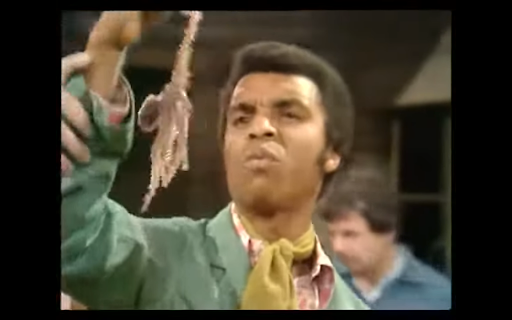
1:35-1:45
Kenny9, a black factory worker, is picking through plastic toy bugs and sorting them in boxes.
Arthur, Kenny’s white boss, comes up behind Kenny to inspect his work as Kenny is10 holding up a large brown spider.
Arthur: Got your lunch then.
Both Arthur and Kenny laugh, Arthur walks behind Kenny to leave, passing him before turning around and addressing him seriously.
Arthur: It’s just a joke!
Kenny: Yeah, yeah…
Arthur exits and Kenny continues his work.
Photo Two: Racist Remark
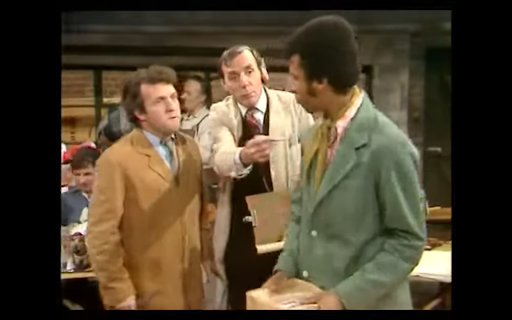
2:21-3:48
In his office, Arthur is sitting at his desk testing toy props looking down while Kevin O’Grady11, an Irish-Pakistani worker is standing to his right.
Arthur: If those are explode-able boots, we’ve got enough, thank you.
Kevin (in an exaggerated Indian accent): Oh, no. I am from the unemployment exchange12. They are telling me there might be a job here.
Arthur: Ah, there is!
Arthur looks up to see Kevin is not a white man and makes a disgusted face. He looks Kevin up and down before standing up from his desk.
Arthur: Well, then again, there might not be. Are you from India?
Kevin: Pakistan.
Arthur: (slaps desk a few times) Pakistan, sure. Hang on a second.
Arthur exits his office, leaving Kevin, and enters the factory work area to go consult Norman.
Arthur: Norman!
Norman mumbles in acknowledgment.
Arthur: I’ve got a new hand starting.
Norman13 (facing away from Arthur): About time.
Arthur: There’s a labor shortage, and uh, it’s a job to get people these days.
Norman: It’s the bloody wages.
Arthur: Yeah, but don’t start that— was your lot that brought the wages freeze in. He’s a— He’s a foreign gentleman.
Norman turns to face Arthur with an angry tone.
Norman: He what?
Arthur: Pakistani.
The camera moves to include Kenny working in the foreground of the shot, while Arthur and Norman are arguing behind him.
Norman (gesturing angrily at Kenny) Now listen, we’ve got our coloured clothes, we don’t want anymore blacks.
Arthur (Walking towards Kenny and gesturing): You can’t count him, he’s British. He was born in London.
(Kenny walks away and the camera focuses back on Norman and Arthur)
Arthur: Look, I— He’s not black, well only in colour.
Norman: Well, that’s how we tell ‘em isn’t it— by the colour, I mean that’s all we’ve got to go on.
Arthur: All right, I know he looks black…
Norman: Well he’s black enough for me.
Arthur: You’re biased, you are. You call yourself a laborer and you can’t stand blacks. You’re not a laborer, you’re a fascist that’s what you are!
(Norman interrupting Arthur)
Norman: No, listen, listen. I voted on labor on’me life, and me father before me, but when it comes to blacks— I’m with Enoch14.
Arthur: Right, but it was your lot that brought in the Race Relations Bill15.
Norman: Mistake.
Arthur: Nevertheless! Either I start him, or the firm gets fined, or I do.
Norman: If you do start him you might have a strike on your hands.
(Kenny enters the scene between Norman and Arthor to interject before quickly returning to his work.)
Kenny: Quite right Norman.
Norman: Yeah.
Arthur: Now Norman, let’s be reasonable. Let’s come to some sort of a compromise.
Norman: All right. (Gestures to Kenny at his workstation) Sack him, then you can start him.
(Laugh track plays)
Kenny: Do what?
Arthur: No, alright. I can’t sack him— I go to football with him (again gestures to Kenny as he leaves).
Photo Three: Racist Remark
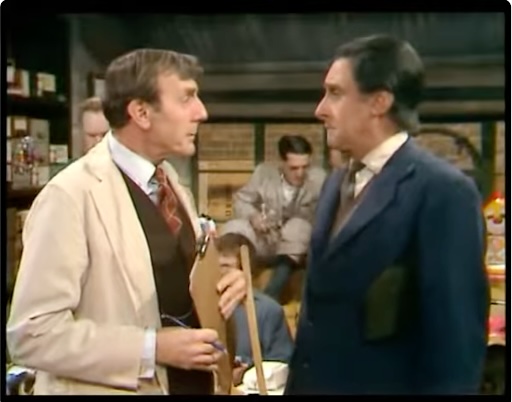
2:39 - 5:25
Arthur comes into the factory to tell Norman that they have a new “Scotty” due to the labor shortage. Arthur tells Norman that the new hire is a foreign man. Norman becomes upset at hearing this news from Arthur. Norman becomes annoyed and says they already have another colored person working. Norman and Arthur briefly talk about the labor, and Kevin walks up behind Arthur. Kevin introduces himself as Kevin O’Grady.
Arthur: He’s Irish.
Norman: Irish!? Well show us your passport
Arthur: Nobody has to show a passport to start working here. Where’s your passport (speaking towards Norman).
Norman: I haven’t got one.
Arthur: Yeah, well I don’t know what you are then. You could be colored.
Norman becomes angry at Arthur’s words towards him.
Norman: Listen, all right cocky, but If I’ll be not gettin’ in, the eyes will have trouble too.
Norman starts to walk away
Norman: I tell you what, if they sent all the wogs16 back home, we’d have an extra hour of daylight.
Arthur and Norman turn and look at each other.
Arthur: Don’t worry about him, he’s wog-mad
Kevin: Oh, no. He’s right There are far too many wogs in this country. I leave Pakistan because there are far too many wog there. So, I come to England, and there are still too many wog.
Arthur: But, you’re one!
Kevin: Oh, no. I’m Irish! Mick, red-face mick. We gotta be Jesus.
Kevin does the Sign of the Cross.
Arthur: All right, Patrick (referencing Kevin), let’s get down to some work.
Kevin: Oh, look. You’ve been very kind to me, so I work very hard for you. I work… hard, hard, hard!
Arthur: Well not too hard, lad.
Arthur brings Kevin over to a table to introduce him to more workers.
Photo Four: Stereotype
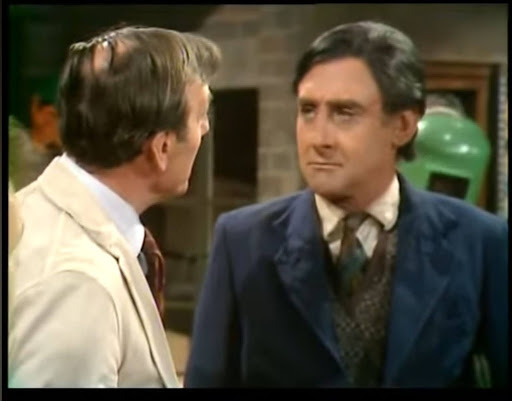
3:58-4:15
After trying to reassure his workers that the new employee will be satisfactory, saying to wait till they see him, the boss, Arthur, turns to be directly face-to-face with Kevin, nearly touching him. Arthur exclaims in surprise, and touches Kevin’s shoulder to shift him back.
Arthur: What’s your name?
Kevin: O’Grady.
A laugh track plays while Arthur stares at him.
Kevin: Kevin O’Grady.
Arthur: That’s an Irish name!
Kevin: Yes, I’m Irish.
The joke is that Kevin subverts their expectation of having a typical South Asian name, and is mixed Irish-Pakistani.
Photo Five: Workplace stereotype
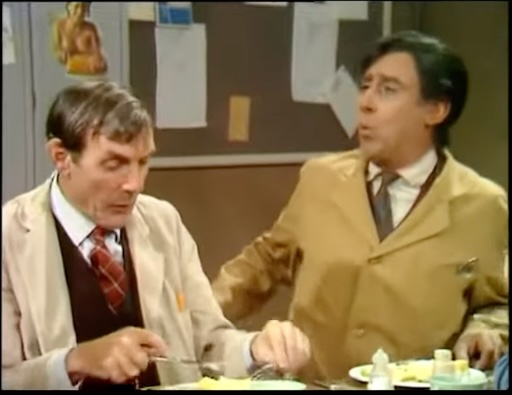
6:35 - 7:14
The workers all get their lunch and sit down at a table to eat. Kevin pours a heavy amount of salt on his food. Arthur stares at Kevin with his hand out as a gesture for the salt. While this is happening, there is background laughter and small talk. A young woman, who works at the factory, walks into the lunchroom.
A few people whistle towards the woman as a cat-call and Kenny stares at the woman as she walks away.
Kevin: Oh, why does, what is that? Why does it do that?
Kevin keeps pouring salt on his food
Arthur: Oh, the whistle. Well, that’s British. That’s chivalry. Oh yeah, that’s to indicate to the young lady that she is… um
Arthur pauses for a moment and Norman jumps into the conversation.
Norman: Crumpet17.
Kevin begins to whistle towards the young woman
Kevin: Do you young crumpet lady?
Arthur looks around to see if the young woman reacts.
Photo Six: Satire and Racism
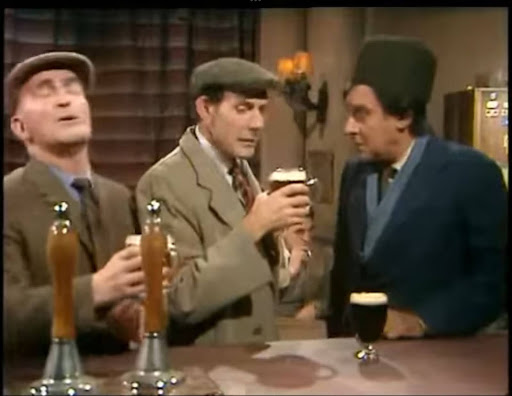
15:00-15:22
Arthur brings Kevin to the local bar that he frequents, to try and make Kevin feel more comfortable in a hostile work environment. The other patrons, Tom and Dick, give him flack for being a foreigner and being ‘colored.’ Kevin does not know what to order, so the others are suspicious that he may be a Muslim that would not drink, despite Kevin insisting against that. They give him a Guinness, a dark Irish beer, while everyone else is drinking lighter beers. Kevin takes offense from this, misunderstanding the intent.
Tom, Dick, and Arthur raise their drinks: Cheers!
Kevin: Ah! Why you give me black drink?!
Arthur looks at the other bar patrons in shock and disbelief. Kevin puts a hand to his heart, offended.
Kevin: Is it– is it because I am colored!?
Tom throws his head back in exasperation.
Tom: God Almighty!
Arthur: No, no, Guinness is always black, it’s got nothing to do with the color. Look, if I had a Guinness, it would still be black!
Kevin: So why don’t you drink Guinness? Arthur, why aren’t you drinking the Guinness?
Arthur, losing his temper: Because I don’t like Guinness!
Arthur turns, venting his frustrations: You bend over backwards for them!
Relevant Information
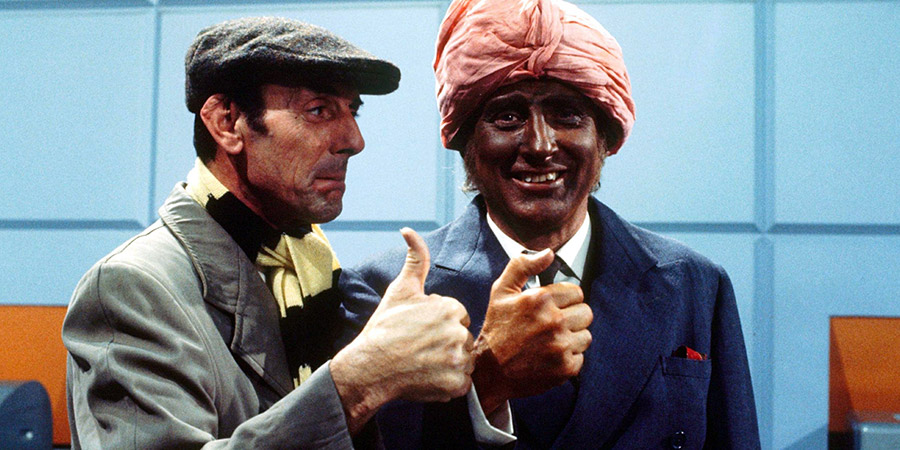
Actor Spike Milligan used blackface to portray an Irish-Pakistani worker. Blackface has been used in the film industry since the early nineteenth century in the United States as a function to dehumanize Black people.18
Bibliography
Alexander, Richard. “BRITISH COMEDY AND HUMOUR: SOCIAL AND CULTURAL “BACKGROUND.” AAA: Arbeiten Aus Anglistik Und Amerikanistik 9, no. 1 (1984): 63–83 [http://www.jstor.org/stable/43023313]](http://www.jstor.org/stable/43023313)
Bebber, Brett. 2023. “South Asians in Britain,” October, 32–42. https://www.taylorfrancis.com/books/edit/10.4324/9781003327363/routledge-handbook-south-asian-migrations-ajaya-sahoo]
Bebber, Brett. 2014. “The Short Life of Curry and Chips: Racial Comedy on British Television in the 1960s.” Journal of British Cinema and Television 11 (2-3): 213–35. https://www.euppublishing.com/doi/abs/10.3366/jbctv.2014.0204]
Bebber, Brett. 2014. “Till Death Us Do Part: Political Satire and Social Realism in the 1960s and 1970s.” Historical Journal of Film, Radio and Television 34 (2): 253–74. [https://www.tandfonline.com/doi/abs/10.1080/01439685.2013.847647]
Bebber, Brett. “‘We Were Just Unwanted’: Bussing, Migrant Dispersal, and South Asians in London.” Journal of Social History 48, no. 3 (2015): 635–61. [http://www.jstor.org/stable/43919790]
| Blackface: The Birth of an American Stereotype | National Museum of African American History and Culture, [nmaahc.si.edu/explore/stories/blackface-birth-american-stereotype]. |
“Definition of Sambo | Dictionary.com. n.d. https://www.dictionary.com/browse/sambo]
“Dictionary.com | Meanings & Definitions of English Words.” 2023. Dictionary.com. 2023. https://www.dictionary.com/browse/wog]
Geddes, Graham Edward. 2016. “Keyboard Warriors: The Production of Islamophobic Identity and an Extreme Worldview within an Online Political Community,” Cambridge Scholars. Publishing. pp. 132–133.Gish, Oscar. “Color and Skill: British Immigration, 1955-1968.” The International Migration Review 3, no. 1 (1968): 19–37. https://test.nypl.org/research/research-catalog/bib/b21102663]
King’s Printer of Acts of Parliament. “Commonwealth Immigrants Act 1962,” n.d. https://www.legislation.gov.uk/ukpga/Eliz2/10-11/21/contents/enacted]
Paton, G. E. C. 2002. That Was Satire That Was, Humor: International Journal of Humor Research, 15(1), 115. Shah, Samir. 2020. “Racism and the Success of British Indians.” The Spectator, June [https://www.proquest.com/magazines/racism-success-british-indians/docview/2414226306/se-2]
Ward, Paul. 2022. “Empire and Decolonisation.” Routledge EBooks, December, 158–73. https://www.researchgate.net/publication/366108878_Empire_and_decolonisation]
Wilson, Amrit. “‘Mercy and Wisdom of a Government’?: Race, Culture and Immigration Control.” In Dreams, Questions, Struggles: South Asian Women in Britain, 72–95. Pluto Press, 2006. https://www.jstor.org/stable/j.ctt18dzts9]
Woods, Rebecca. 2016. “Racism and Ignorance in 1966 England.” BBC News, June 1, 2016, sec. Birmingham & Black Country. https://www.bbc.com/news/uk-england-birmingham-36388761
Credits and Acknowledgments
We would like to thank Professor Antoinette Burton for her insightful discussion on 1960s racism and the powerful role of satire in shaping and deepening our understanding of Curry and Chips.
How to Cite:
Corso, Nick, Falk, Shulamit, and Wilson, Lakyn. “Curry and Chips: Racism and Satire in 1960’s British Television.” December 7, 2025. [nickcorso02.github.io/currychips/]
About MinDoc 1.0
This site was built using MinDoc 1.0, a prototype digital documentary edition template developed for classroom use by members of SourceLab at the University of Illinois Urbana-Champaign. The original project team included Liza Senatrova, John Randolph, Caroline Kness, and Richard Young.
References
-
Gish, “Color and Skill: British Immigration, 1955–1968.” ↩
-
King’s Printer of Acts of Parliament, “Commonwealth Immigrants Act 1962.” ↩
-
Bebber, “The Short Life of Curry and Chips: Racial Comedy on British Television in the 1960s.” ↩
-
Alexander, “British Comedy and Humor: Social and Cultural Background.” ↩
-
Alexander, “British Comedy and Humor: Social and Cultural Background.” ↩
-
Bebber, “Till Death Us Do Part: Political Satire and Social Realism in the 1960s and 1970s.” ↩
-
Speight, Johnny. “Curry and Chips.” ↩
-
Internet Archive ↩
-
Kenny Lynch, a Black musician and television actor, was one of the few Black British singers in popular music. ↩
-
Eric Sykes, television actor born in England. ↩
-
Actor Spike Milligan in brown face ↩
-
The Local Employment Acts of 1960 and 1963 were put in place with the purpose of cutting back high unemployment rates. Thirlwall, A.P. “The Local Employment Acts 1960 and 1963: A Progress Report.” ↩
-
Norman Rossington, British actor born in Liverpool. ↩
-
British political figure, Enoch Powell, who gave the ‘River of Blood’ speech in 1968. ↩
-
Expanded from the 1965 Act, the 1968 Race Relations Act “focused on eradicating discrimination in housing and employment.” UK Parliament. “1968 Race Relations Act.” ↩
-
Used as an insulting and contemptuous term for a dark-skinned foreigner and especially for one from the Middle East. ↩
-
British slang term used to refer to women in an inappropriate manner. ↩
-
By distorting the features and culture of African Americans—including their looks, language, dance, deportment, and character—white Americans were able to codify whiteness across class and geopolitical lines as its antithesis. ↩